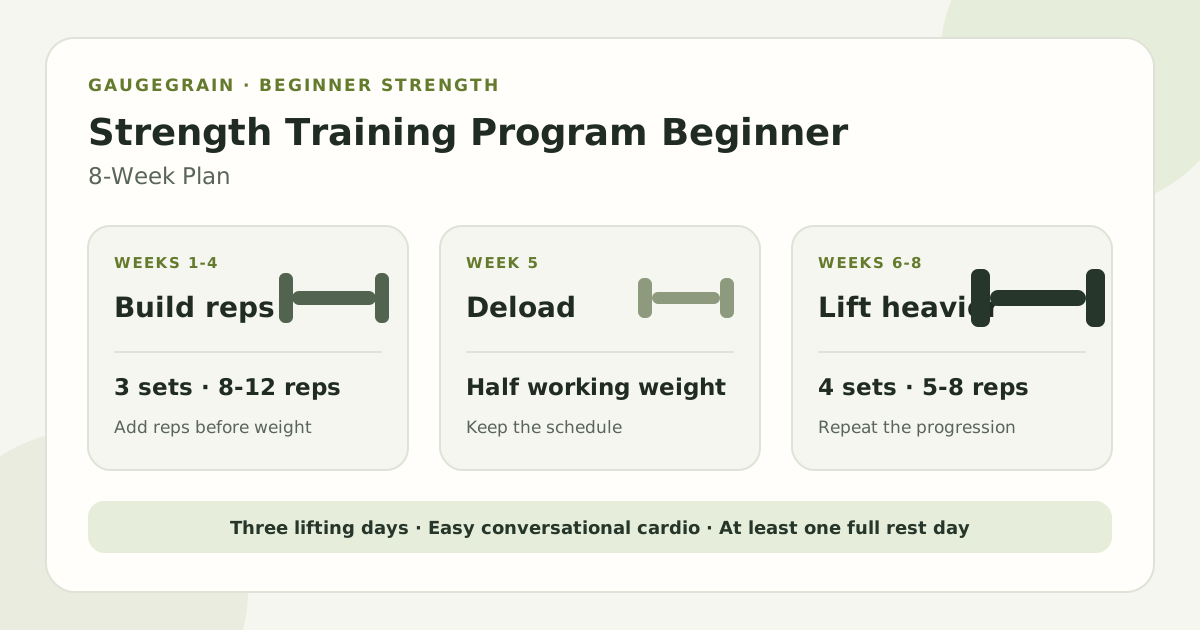
For an eight-week beginner strength plan, lift three days per week, with two or three cardio slots and at least one full rest day. Alternate two workouts covering squat, hinge, horizontal push and pull, and vertical push and pull. Add reps before weight, deload in week 5, then repeat the cycle heavier for weeks 6–8.
Key takeaways
- Beginners should lift three days a week, leaving room for two or three cardio slots and at least one full rest day.
- The plan covers six movement patterns: squat, hinge, horizontal push and pull, and vertical push and pull.
- Double progression, adding reps before weight, makes the decision to increase load mechanical instead of guesswork.
- Week 5 is a deload at roughly half your working weight; weeks 6-8 then repeat the cycle heavier.
- Cardio belongs on separate days or after lifting, kept conversational, with at most one hard interval session a week.
Below is a full 8-week beginner schedule: three lifting days of progressive barbell or dumbbell work, layered around your cardio or sport and sized to your logged weight, body fat and calories.
How many days a week should a beginner lift?
Three. It gives each muscle group roughly 48-72 hours of recovery, fits most schedules, and leaves room for the cardio or sport you already do.
Two days works but slows progression on each lift. Five days is where concurrent training starts costing you: a meta-analysis by Wilson et al. found that combining endurance and strength training blunted strength and power gains compared with strength training alone, with longer, more frequent cardio showing the most interference (Wilson et al., Journal of Strength and Conditioning Research). Three lifting days plus two or three cardio slots keeps that manageable.
What should week one include?
Six movements: squat, hinge (deadlift or Romanian deadlift), horizontal push (bench press or push-up), horizontal pull (row), vertical push (overhead press) and vertical pull (lat pulldown or assisted pull-up). Split them into two workouts and alternate them across your three days (A-B-A one week, B-A-B the next).
| Workout | Lifts |
|---|---|
| A | Squat, bench press, row |
| B | Romanian deadlift, overhead press, lat pulldown or assisted pull-up |
Finding your starting weight: use logged body weight as a rough anchor. Start around 40-50% of body weight on squat and deadlift patterns and 20-30% on presses, then adjust. If a set of 8 feels smooth with two reps left in the tank, that's your load. If your weight or body-fat percentage is well above or below average, scale accordingly rather than copying a template.
Sets, reps and rest: 3 sets of 8 on each lift, resting 2-3 minutes between sets. Log every set so week two has a baseline. A plan built from your measurements, like GaugeGrain's, starts from these numbers instead of generic defaults, though it assumes you already track consistently.
How do you combine cardio and strength in one week?
Cardio slots around your lifting days, not on top of them. The NSCA stresses recovery between sessions for beginners, so the default is: lift Monday, Wednesday and Friday; run or cycle Tuesday and Saturday; take at least one full rest day.
Separate days are the beginner default because they protect progression. Same-day works if your schedule forces it, but lift first and keep cardio short; running hard before squats degrades every rep after it.
Keep cardio conversational on lifting-adjacent days, and put any harder session on the day furthest from your heaviest lift. If you're cutting, add cardio gradually rather than dropping calories further. How that interacts with your logged numbers in Cronometer or MyFitnessPal is covered in how GaugeGrain compares on logging.
Can you run without losing strength gains?
Yes, if you keep running volume and intensity in check. The interference effect means long, hard endurance sessions can blunt strength adaptation, mostly when they land close to lifting and total recovery runs short. For a beginner, the bigger risk is under-eating, not running. A deficit already slows progression; stacking 25 miles a week on top makes it worse.
A running-friendly week:
- Run on lifting days (after the weights) or on off days, never before a lower-body session.
- Cap easy runs at 20-30 minutes.
- Hold to one hard interval day at most during the 8 weeks.
Fitbod programs lifts but leaves cardio scheduling to you (https://fitbod.me), which is why combined plans get pieced together by hand; see our Fitbod comparison (https://gaugegrain.com/vs/fitbod).
What changes for a female beginner?
Starting loads and pace. Most women start with proportionally stronger lower bodies, so squats and hinges progress faster than presses: expect to add weight to lower-body lifts weekly and upper-body lifts every other week. Menstrual cycle phase can affect perceived effort and recovery, so some weeks you'll hold loads steady. If you're cutting, protein and calorie targets matter more than any exercise swap.
The structure doesn't change: three lifting days, progressive overload, the same cardio layering. A plan built from your logged body-fat percentage and macros doesn't need a separate female template. GaugeGrain builds one schedule from anyone's baseline, unlike single-purpose trackers such as MyFitnessPal (https://gaugegrain.com/vs/myfitnesspal).
How does a baseball program differ?
Baseball adds two demands a generic plan ignores: rotational power and shoulder durability. The lifting days stay; exercise selection shifts.
- Swap some pressing volume for med-ball rotational throws, band pull-aparts and external rotation work.
- Pitchers and catchers carry the heaviest throwing loads, so cut their overhead pressing further.
- Keep rows and face pulls in every session; the throwing shoulder fails from imbalance, not weakness.
Off-season, run the full 8 weeks at normal volume. In-season, cut lifting volume roughly in half, keep the intensity, and never program hard lower-body work the day before a game. The in-season goal is maintenance, not progression.
How do you progress week by week?
The plan uses double progression on every lift. Pick a rep range (8-12 in weeks 1-4). Start at the bottom with a weight you can handle for all sets, and add reps each session. When you hit the top of the range on every set with clean form, add 5 lb to upper-body lifts or 10 lb to lower-body lifts (or move to the next dumbbell) and drop back to the bottom of the range.
Rep ranges, not fixed reps, take the guesswork out of adding weight. If you stall two sessions in a row at the same weight, it's too heavy for now.
Week 5 is a deload: same lifts and sets at roughly half your working weight. Weeks 6-8 then repeat the cycle a step heavier than week 1, because you earned it.
The full 8-week schedule
Weeks 1-4
- Mon/Wed/Fri: alternate workouts A and B, 3 sets of 8-12 with double progression, starting at a weight you could lift for about 10.
- Tue/Sat: 20-30 minutes of easy, conversational cardio.
- Thu/Sun: rest.
Cardio stays easy here while you learn bar paths and build the connective-tissue base to recover from both. Throwing athletes should add rotator-cuff band work on lifting days.
Week 5
- Deload: same schedule, half the working weight, easy cardio only.
Weeks 6-8
- Lifting: 4 sets of 5-8 with double progression, starting heavier than week 1.
- Cardio: one easy session stays; the other becomes intervals, one minute hard and two easy, six rounds in week 6, building to eight by week 8.
- Rest days stay untouched.
How do your logged numbers shape the plan?
The same schedule runs differently depending on your calorie target. On a cut, expect slower progression: a 500-calorie deficit with high protein preserves muscle, but don't expect to add weight every week. On a bulk or at maintenance, progression comes faster. If your body-fat percentage is above roughly 25% (men) or 30% (women), most coaches suggest starting at maintenance or a small deficit and letting the lifting do its work. Log weight and measurements weekly, not daily, and adjust calories every two to three weeks based on the trend.
Where GaugeGrain and other tools fit
GaugeGrain starts from your measurements: you enter weight, body-fat percentage and calorie baseline, and it layers workouts, meals and fasting windows on top, for $19.99/month with $5.99 add-ons. It lacks Hevy's set-and-rep logging depth and Cronometer's micronutrient detail, so serious lifters may keep those alongside it. MyFitnessPal and Fitbod cover calorie tracking and progression separately; GaugeGrain's bet is that one baseline beats three disconnected apps.
FAQ
Should I do cardio before or after lifting?
After. Running hard before squats degrades every rep, and lifting progression drives the adaptation you're after. Keep same-day cardio short and easy, and put intervals on the day furthest from your heaviest lower-body lift.
How long until I see visible changes?
Lifts feel smoother within two to three weeks, but visible muscle usually takes six to eight weeks of consistent training and adequate eating. Weekly logged measurements beat the mirror.
Can I do this at home with dumbbells?
Yes, with adjustable dumbbells. Squats, Romanian deadlifts, rows and overhead presses translate directly. The sticking points are vertical pulls and heavy lower-body loading once you outgrow the dumbbells, usually around weeks 6-8. A pull-up bar solves the first; the second may justify a barbell or gym membership.
What should I eat before a morning session if I usually fast?
A small meal beats true fasting for beginners: some protein and carbs 30-60 minutes before, like Greek yogurt with fruit or a banana with whey. Fasted lifting works for easy sessions but tends to cost reps on heavy sets, especially in a deficit.
Is 30 minutes of lifting enough?
Yes, if you use it well. Three lifts of three sets with tight rests fits in roughly 30-40 minutes. What matters is hitting all six patterns across the week and adding reps or weight, not the clock. Longer sessions mostly add fatigue at this stage.