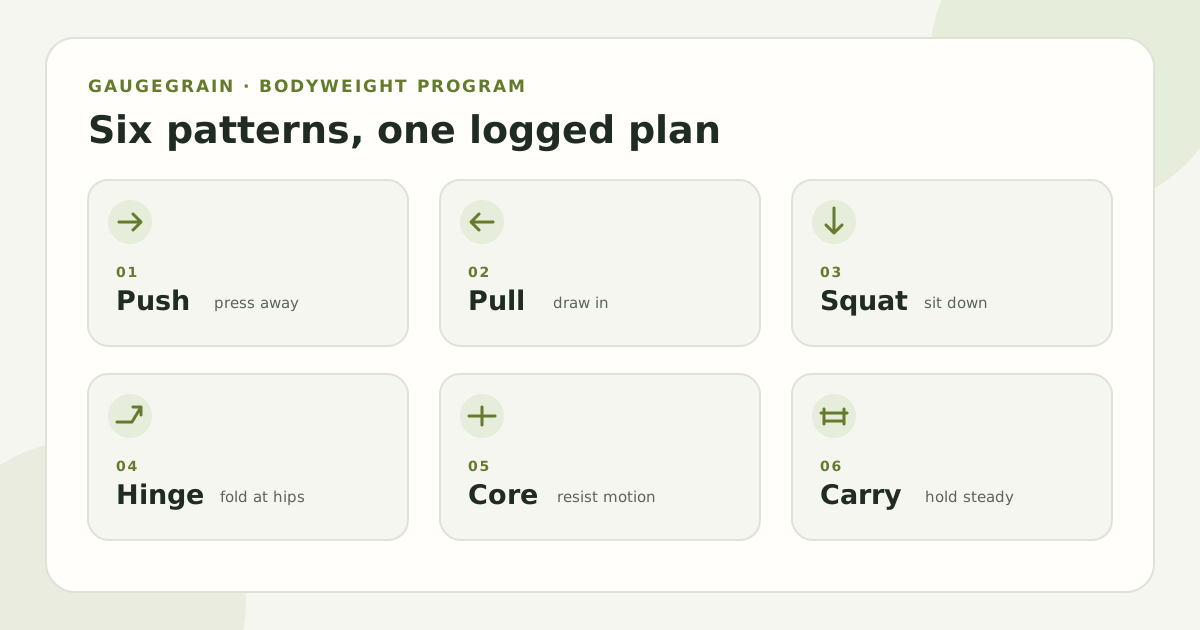
A strength training without weights program can train six patterns—push, pull, squat, hinge, core, and carry—by changing exercise leverage and tempo as reps improve. This 12-week plan starts with a logged baseline, then advances one variable at a time using rep targets and written tempos. It includes regressions, cutting guidance, and marathon-training maintenance notes.
Key takeaways
- A bodyweight program needs four things: exercises with regressions, goal-suited rep ranges, a measurable progression trigger, and a logbook.
- Six movement patterns (push, pull, squat, hinge, core, carry) cover everything a no-equipment plan requires.
- Advance only after hitting the rep target at the written tempo in two consecutive sessions, and change one variable at a time.
- While cutting, work in 5-12 reps with 2-3 hard sets per pattern. Stalls around weeks 7-9 usually point to intake, not programming.
- Alongside half or full marathon training, cap strength at two 30-40 minute maintenance sessions, 48+ hours from your longest run.
Below is a 12-week bodyweight plan where every exercise has a regression, an advancement trigger, and fixed sets, reps and tempo, for cutting or maintaining, with notes for marathon training.
What does a strength training without weights program need?
A list of push-ups and squats is raw material, not a program. A program says what to do, how much, when to do more, and how you'll know it worked. Resistance training helps preserve lean mass in a deficit, but only when volume and progression are deliberate.
The four-component checklist:
- Exercise selection with a named regression and advancement for each movement.
- Sets and reps in ranges that suit your goal: cutting or maintaining.
- A progression rule tied to a measurable trigger, like reps achieved or tempo held.
- A log, so week 1 and week 12 are comparable.
Audit any plan against these four; ours falls short anywhere a trigger can't be tied to a logged number.
Which exercises belong in a beginner no-equipment program?
Map each pattern to one primary exercise with a regression and an advancement:
- Push: incline push-ups (hands on a counter), then knee, full, and feet-elevated push-ups.
- Pull: table rows, lying under a sturdy table and pulling your chest to the edge. Progress by walking your feet further out or slowing the lowering phase to 3 seconds.
- Squat: bodyweight squats, then split squats, then pistol progressions.
- Hinge: single-leg Romanian deadlifts, where balance and tempo stand in for load.
- Core: planks and dead bugs to resist extension. Progress with longer levers or holds.
- Carry: a suitcase hold with a heavy household object.
| Pattern | Exercise | First regression | First advancement |
|---|---|---|---|
| Push | Push-up | Incline push-up | Feet elevated |
| Pull | Table row | Higher table | Feet closer to table |
| Squat | Bodyweight squat | Sit-to-stand from chair | Split squat |
| Hinge | Single-leg RDL | Both legs | Eyes closed |
| Core | Plank | Knee plank | Long-lever plank |
| Carry | Suitcase hold | Lighter object | Longer hold |
GaugeGrain programs each pattern against your own logged baseline rather than a generic template. See: GaugeGrain — a personal fitness plan built around your numbers.
How should sets, reps and tempo be structured when cutting?
In a deficit you're training to keep strength. Work in 5-12 reps: 5-8 on harder progressions (pike or pseudo-planche push-ups) to hold strength, 10-12 on easier variations for enough volume without wrecking recovery. Two to three hard sets per pattern is enough.
Pick a variation you fail at in 5-12 reps. If you can do more than 12 clean reps, it's too easy for strength retention, so advance it. (We apply the same audit-the-rule logic when comparing progression systems like Fitbod.)
Tempo is written eccentric-pause-concentric: a 3-1-1 squat is three seconds down, one paused, one up. Slower eccentrics add difficulty without reps.
Rest 2-3 minutes between hard sets; short rests degrade rep quality and hide your progression triggers. Keep sessions to 30-45 minutes so they fit alongside running, since concurrent training research shows endurance work can blunt strength adaptations (Wilson et al.'s concurrent-training meta-analysis; Schoenfeld et al., concurrent training review).
The 12-week progression, week by week
Each exercise has four columns: sets, reps, tempo, and the trigger that moves you up or down. Log the trigger result every session.
Weeks 1-4: baseline
This is a rep census. Each primary exercise gets 3 sets, stopped two reps short of failure, at a 2-1-2 tempo. Record honest max reps per set. If you can't hit 8 clean push-ups, drop to incline push-ups and log that as your baseline. Nothing advances yet; the data comes first.
Weeks 5-8: tempo and leverage
Change the stimulus, not the exercise. Once you hit the top of the rep range at the current tempo on all sets, two sessions in a row, slow the eccentric (e.g. to 3-1-2) or shift leverage (e.g. feet-elevated push-ups). Regressions get a trigger too: two sessions in a row below the bottom of the range means stepping back one level rather than grinding junk reps.
The log has to be truthful. Rounding 7 reps up to 8 corrupts the trigger, and the trigger is the whole program. That's why GaugeGrain starts from measurements you supply, and why we compared our tracking approach with Cronometer's.
Weeks 9-12: harder variations and density
Swap in archer push-ups, pistol squat progressions and feet-elevated rows. Density work replaces some sets: cut rest from 90 to 60 seconds while holding reps. The trigger keeps its shape: hit the target on the new variation twice, then advance again.
When do you regress or advance?
The one-lever rule: change exactly one variable at a time, whether reps, tempo, or a harder progression. Moving from knee to full push-ups while also slowing to 4-1-1 stacks two jumps and hides which one you earned. Regress the same way: drop one lever, retest, and only touch a second if the stall repeats.
A stall means missing the rep target at the prescribed tempo and rest, two sessions running, on the same exercise. First response: regress one lever. If three exercises stall in the same week, the problem is systemic: deload for a week at about half the volume, keep the tempo work, then retest. While cutting, expect a deload every 6-8 weeks rather than fighting the deficit with volume.
Stalls clustering in weeks 7-9 of a cut usually point to intake. The ISSN position stand on diets and body composition supports higher protein during caloric restriction to preserve lean mass. GaugeGrain applies these trigger rules automatically from your logged sets and reps, but it can't read fatigue or sleep the way a coach watching you train would. If you track macros in MyFitnessPal, see GaugeGrain vs MyFitnessPal for how the baselines differ.
Can this run alongside half or full marathon training?
Yes, if you cap strength at two sessions and treat them as maintenance. Stop advancing exercises and hold your current level.
- Schedule both sessions 48+ hours from your longest run, ideally the day after an easy run rather than the day before.
- Same-day doubles work only if strength comes first and the run is short.
- Keep sessions to 30-40 minutes: two lower-body and two upper-body patterns, two sets each.
- In the two highest-mileage weeks before race day, drop to one session with half the sets, holding tempo and rest constant. Resume full volume the week after the race.
How do you track progress when the load never changes?
With no plates to add, leverage, tempo and rest are your progression variables, so log them with barbell-level discipline. Eight push-ups at 2-1-2 with 90 seconds' rest is a different set from ten at 3-1-1 with 60 seconds' rest.
Keep one line per exercise per session: tier, reps, tempo and rest. Add weekly weight, body-fat percentage and first-meal time to the same log, so strength and composition sit side by side.
GaugeGrain builds the plan from your measurements ($19.99/month, $5.99 add-ons), so the composition side is covered. The gap: it doesn't log per-set tempo and rest, so keep a separate spreadsheet for the progression table. Fitbod adjusts bodyweight exercises by reps and difficulty, and Hevy handles clean set-by-set logging, but neither starts from your body-fat baseline, so pair one with your measurement tracking.
How should calorie and macro tracking align with the plan?
Set your deficit from your logged baseline: roughly 300-500 calories a day below maintenance suits a 12-week cut while sets and reps keep progressing. Aim for about 0.7-1.0 g of protein per pound of bodyweight, a common range for preserving lean mass. On maintenance weeks, eat at your logged maintenance and let the progression table, not the scale, tell you whether intake is right.
The same numbers should drive training and eating. MyFitnessPal and Cronometer handle food; GaugeGrain builds workouts, meals and fasting windows from your body measurements. It doesn't replace a dedicated food database, so you may still track calories separately.
FAQ
How soon will I see strength gains?
Expect measurable rep improvements within 2-3 weeks, which is why weeks 1-4 are a rep census. After early beginner gains, progress comes from tempo and leverage. In a deficit it's slower, and stalls around weeks 7-9 usually point to intake.
Can I build muscle with bodyweight training, or only maintain?
Beginners can build muscle by progressing leverage, tempo and harder variations like archer push-ups and pistol work. Once a variation is easy past 12 reps, advance it or growth stalls. While cutting, the realistic goal is preserving lean mass.
Should I train fasted if I do intermittent fasting?
It's optional. Fasted sessions tend to cost rep quality, and rep quality is your progression trigger. Train fed if your eating window allows; if not, keep it short and log honestly.
What if I can't do a single push-up?
Start with incline push-ups against a counter, then knee push-ups, then full. Log your baseline at that level and apply the same triggers: hit the target twice in a row, then step up.
Do I need rest days between sessions?
Yes. Space hard sessions at least 48 hours apart (48+ hours from your longest run if marathon training).