Key takeaways
- A five-day hybrid of push/pull/legs and upper/lower trains each muscle twice a week while keeping sessions short enough to recover from in a calorie deficit.
- Set protein from lean body mass (about 0.8–1 g per pound), not total bodyweight, so your target stays accurate as body fat drops.
- Weigh in daily before eating or drinking, but judge progress by weekly averages. Bioelectrical impedance readings can swing 0.5% overnight.
- If your weekly average stalls for three weeks, change one thing: cut 100–200 kcal or add volume, never both.
- Keep protein the same every day and shift carbs toward training days, so a weak session has a checkable cause.
The best weight-loss training plan works as one system. Each training day comes with a tracking routine. Macros are set from your logged weight and body-fat percentage. Weigh-ins follow a fixed routine, and your fasting window lines up with your first meal. Below is the full weekly template, day by day.
How many days per week should you train?
For most people on a cut, five lifting days works better than three. That's not because extra sessions burn much more energy. More sessions let you spread volume out, keep each workout high quality, and stay consistent while eating less.
The cited frequency studies do not establish that five days works better than three for most people in a calorie deficit.
A meta-analysis by Schoenfeld et al. in Sports Medicine found that when weekly volume is equal, training frequency produces similar muscle gains (Schoenfeld et al.'s frequency meta-analysis). For strength, a separate meta-analysis found no significant frequency effect when combined exercise volume was equated (Ralston et al.'s strength meta-analysis). A 24-week randomized trial of 39 women aged 60 and older also found similar strength and muscle outcomes with two versus three weekly whole-body sessions (Pina et al.'s resistance-frequency trial); that study did not test people dieting or compare five with three days. Frequency is a scheduling tool, not a fat-loss multiplier. Choose the schedule you can recover from and repeat for months.
- Four days: best for a demanding job or poor sleep.
- Five or six days: works if you enjoy training and can eat and sleep on schedule.
Why combine push/pull/legs with upper/lower?
Pure PPL needs six days to hit each muscle twice, which is hard to recover from in a deficit. Pure upper/lower gets twice-weekly frequency in four days, but sessions get crowded. Neither fits a cut well.
The hybrid runs five days: three PPL days plus one upper and one lower day. Most muscles get direct work twice a week, sessions stay manageable, and you land around 10–16 hard sets per muscle group weekly. That's enough to hold strength while cutting. The cited volume meta-analysis found a dose-response relationship between weekly sets and muscle growth, but did not test this exact range as a strength-retention threshold during a calorie deficit (Schoenfeld et al.'s volume systematic review and meta-analysis).
Popular templates like Jeff Nippard's PPL are a useful reference, but you can build the same structure yourself. Choose two push, two pull, and two leg movements and spread them across the five days.
What each day includes
Each session pairs one heavy compound lift with two or three accessories. Rest 2–3 minutes between compound sets and 60–90 seconds between accessory sets. The ACSM position stand on resistance-training progression is general guidance for healthy adults, with rest periods depending on training goal and loading; it does not establish these exact intervals for this plan or a calorie deficit.
Push
- Bench or incline press: 3 × 5–8
- Overhead press: 3 × 8–12
- Lateral raises and triceps pushdowns: 2–3 × 12–15
Pull
- Barbell or chest-supported row: 3 × 5–8
- Lat pulldown or pull-ups: 3 × 8–12
- Face pulls and curls: 2–3 × 12–20
Legs
- Squat: 3 × 5–8
- Romanian deadlift: 3 × 8–10
- Leg press or lunges, plus calf raises: 2–3 × 10–15
Upper
Bench plus row as main lifts, about four exercises covering push and pull.
Lower
Squat or deadlift as the main lift, with quads, hamstrings and calves in one session.
How macros shape your training results
Your calorie deficit decides whether you lose weight. Your macros decide whether that weight is fat or muscle. Two people eating 2,000 calories can finish a cut very differently: one holds strength, the other loses reps every week. Protein is usually the difference. This comparison is illustrative; the linked trial below does not test that exact scenario or establish protein as the only difference.
In one four-week randomized trial, young men in a marked energy deficit who followed intense training six days a week were assigned 1.2 or 2.4 g/kg/day of protein. The higher-protein group gained more lean mass and lost more fat, while exercise performance improved similarly in both groups (Longland et al.'s randomized trial). That result applies to this short, demanding study protocol; it does not establish a universal protein target.
Protein from lean mass
Bodyweight-based targets overshoot for anyone carrying extra fat. Subtract your body fat from your total weight, then aim for 0.8–1 g per pound of lean mass. At 180 lb and 25% body fat, lean mass is 135 lb, so the target is about 108–135 g, not 180. Research on lifters in a deficit (Helms et al.) points higher, around 2.3–3.1 g per kg of fat-free mass, so leaner lifters may want the top of the range or above. Update the number as your body fat changes. Helms et al.'s estimate comes from a systematic review of lean, resistance-trained athletes under energy restriction, not a universal target established by the randomized trial above.
Carbs around training
Keep fat moderate and steady. Put more carbs around training days, especially before and after sessions, and trim them on rest days. This isn't a strict rule, but it keeps progress measurable.
Choosing a calorie tracker
On a cut, three things matter: database accuracy, the ability to hit a protein target, and how well the tracker fits your training plan.
- MyFitnessPal: largest food database, but more user-entered errors.
- Cronometer: verified nutrition data and detailed micronutrients, so accuracy compounds daily.
- Lifesum: lighter and meal-focused.
None of these program your sets and reps, so most people pair one with a lifting log like Hevy.
A measurement-first planner such as GaugeGrain takes a different approach. It builds macro, workout and fasting targets from your logged weight and body-fat percentage, and adjusts them as those numbers move.
The trade-offs: its food database is smaller than MyFitnessPal's, it doesn't log individual sets the way Hevy does, and it costs $19.99/month plus $5.99 add-ons.
The accepted offer specifies $19.99/month for the first layer, +$5.99/month per additional layer, and $42/month for all layers. The source material does not reconcile those price statements, so both are retained as supplied without inferring a layer count or recalculating the total.
It also assumes you measure consistently. For the deepest micronutrient data, Cronometer still wins.
On Reddit's r/loseit, opinion usually splits between MyFitnessPal and Cronometer; that is an informal observation, not a representative poll. The honest answer is that the best tracker is the one you'll use every day.
The integrated weekly template
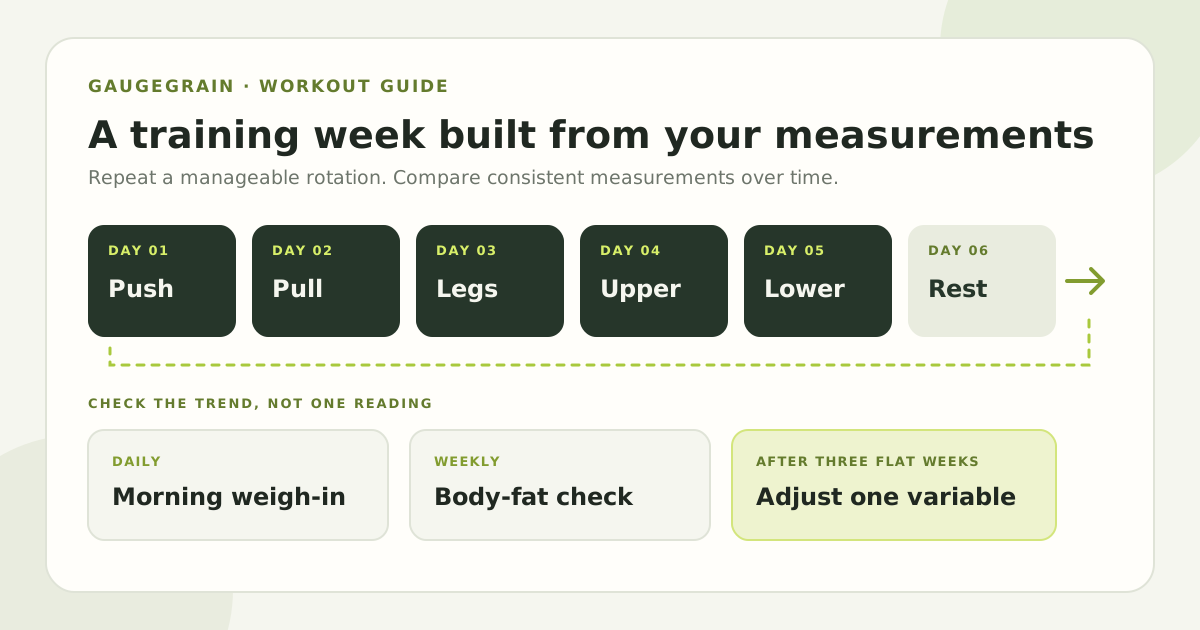
Rotation: push, pull, legs, upper, lower, rest, then repeat.
Daily tracking routine
- Weigh in every morning after waking, before food or water.
- Log body-fat percentage weekly, under the same conditions each time.
- Plan the next day's macros the night before. Set protein first, then fill the remaining calories with carbs and fat based on the next session. Heavy leg days get more carbs.
- On rest days, lower carbs and keep protein the same.
Most plans fall apart because training and nutrition run on separate numbers. The fix is one baseline: your measurements set the macros and the training, and your weekly averages adjust both.
Fasting and meal timing
If you train fasted, anchor your first meal to your hardest session. Leg and lower days benefit most from protein within a few hours after training. Keep the fasting window the same all week so days stay comparable. When your schedule changes, move meals, not the window.
Adapting the plan for women
Many women handle higher per-session volume well at the same relative intensity, so keeping all sets is often better than cutting one. This is a practical suggestion from the supplied draft; the cited sources here do not establish a general sex-specific per-session volume threshold.
Swap heavy free-weight accessories for machine or cable versions, which are easier to load precisely when energy is low. On the big lifts, add reps before adding weight. Expect some weeks across your cycle to feel stronger than others. Adjust the load instead of skipping the session.
Body-fat readings need context. Impedance scales shift with hydration and meal timing, so a 0.5% overnight change is noise. A measurement study found 0.3–0.7 percentage-point variation over 60 minutes in control readings, but it did not establish the exact overnight figure. Judge progress by weekly weight averages, waist measurement and gym performance together.
What to do when weight loss stalls
A stall means your weekly average hasn't moved for two to three weeks. A 0.4 lb jump overnight doesn't count. Water, sodium and the menstrual cycle can mask a real deficit for a week or more. If the average is still falling, even slowly, change nothing.
If it's flat for three straight weeks, change one variable:
- Cut 100–200 kcal from carbs or fat, keeping protein the same.
- Add one set per exercise on upper/lower days.
- Add a walk on rest days.
Keep tracking body fat alongside weight so a recomposition doesn't look like a stall. If your main lifts are dropping, stop cutting calories and eat at maintenance for a week before deciding next steps.
Evidence note: The linked studies do not establish the 0.8–1 g/lb lean-mass target as universal. No source cited here validates the exact stall and overnight-weight thresholds, hydration effects beyond the study's tested meal conditions, water/sodium/cycle masking duration, four-to-eight-week trend window, carb and fasting schedule, post-session protein timing, cycle-related adjustments, or tracker database/error comparisons; treat these as supplied recommendations and product/community observations, not research-verified outcomes.
FAQ
Can I run this on four days instead of five?
Yes. Run upper, lower, push, pull, and rotate the missing leg day into the next week. Or run upper/lower twice weekly with PPL movements folded in. Keep accessories minimal and prioritize the main lifts.
Do I need cardio?
No. Lifting plus a calorie deficit is enough to lose fat. Cardio helps widen the deficit without cutting food further. A rest-day walk is the easiest addition. If you add cardio, change nothing else that week.
How long before body fat changes show?
Expect a readable trend after four to eight weeks. Compare month to month, not day to day.
Should rest-day macros match training days?
No. Keep protein the same, keep fat moderate, and move carbs toward training days. If a leg session feels weak, check the previous day's carbs first.